
Electrolysis Hair Removal: How It Works, Benefits, Side Effects & What to Expect

What Is Electrolysis Hair Removal?
Unwanted facial and body hair is one of the most common aesthetic concerns among both women and men.
There are several ways to remove unwanted hair, including shaving, waxing, threading, depilatory creams and laser hair reduction. Electrolysis hair removal is different because it treats individual hair follicles one at a time using a fine probe and controlled electrical energy.
The goal is to target the growth-producing cells within the treated follicle, helping to prevent that follicle from producing hair again.
Electrolysis can be particularly useful for small, precise areas and hair colours that are difficult to target with laser, including very light, blonde, grey and white hairs.
In simple words:
Laser treats multiple follicles at once using light, while electrolysis treats individual follicles using electrical energy.
How Does Electrolysis Hair Removal Work?
During an electrolysis treatment, a trained practitioner uses an extremely fine probe and guides it into the natural opening of an individual hair follicle.
A controlled electrical current is then delivered through the probe.
Depending on the electrolysis modality, the current can create either a chemical reaction, heat, or a combination of both within the follicle.
The treated hair is then removed.

Why Does Electrolysis Take So Much Time?
This is one of the most important things to understand before choosing electrolysis.
Electrolysis treats hair follicles individually.
If a treatment area contains hundreds or thousands of hairs, the practitioner has to work through those follicles individually rather than treating the entire area with one laser pulse.
For example, laser hair reduction can treat a relatively large area rapidly because one pulse covers multiple follicles.
Electrolysis is different.
One follicle → one insertion → controlled energy → hair removal → next follicle.
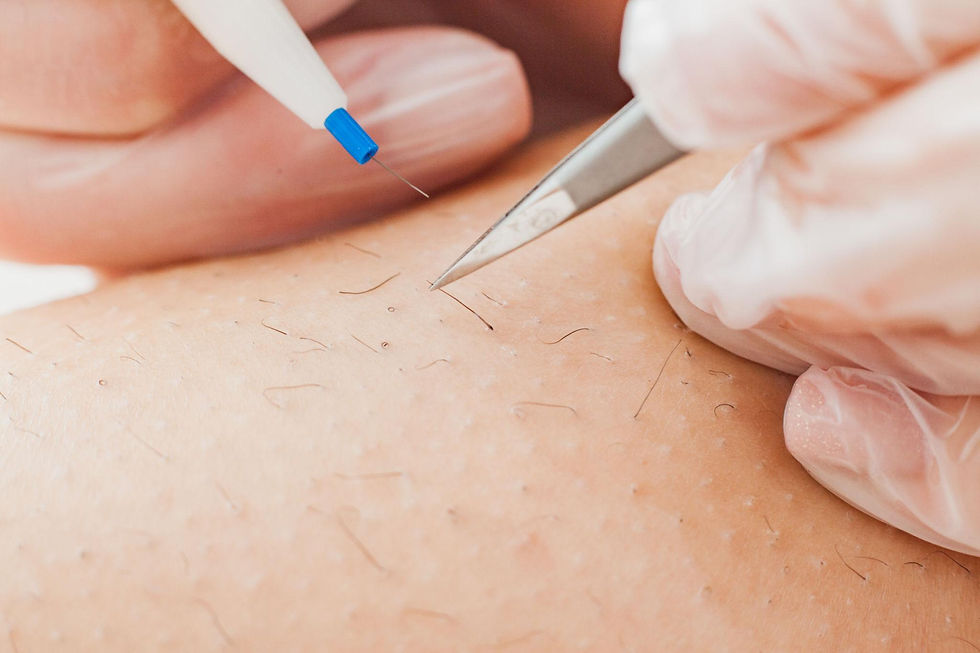
This makes electrolysis particularly useful for precision work, but it is generally less practical for quickly clearing very large areas.
Does Electrolysis Work on All Hair Colours?
This is one of the biggest advantages of electrolysis.
Electrolysis does not depend on the hair having enough pigment for the treatment to work.
It can therefore be considered for:
Black hair
Brown hair
Dark hair
Blonde hair
Light-coloured hair
Grey hair
White hair
Fine hair
Coarse hair
This is particularly important for people with grey, white or very light facial hair, where laser hair removal may be less effective because laser relies heavily on absorption by hair pigment.
Electrolysis vs Laser Hair Removal
Both technologies have their place in professional hair-removal treatment.

Feature | Electrolysis | Laser Hair Removal |
How it works | Electrical energy delivered into individual follicles | Light energy targets pigmented hair/follicle |
Treats individual hairs | Yes | No, treats multiple follicles per pulse |
Light/white/grey hair | Can be treated | Generally difficult or ineffective |
Large treatment areas | Time-consuming | Generally much faster |
Precision | Very high | High, but treats groups of follicles |
Treatment speed | Slower | Faster |
Number of sessions | Multiple sessions usually required | Multiple sessions usually required |
Hair pigmentation required | No | Important for conventional laser targeting |
Suitable for localized facial hairs | Yes | Yes, depending on hair/skin characteristics |
How Many Electrolysis Sessions Are Required?
This is where people often expect a simple number — but there isn't a universal number.
There is no fixed minimum or maximum number of electrolysis sessions that applies to everyone.
The treatment schedule depends on:
Number of hairs
Hair density
Hair thickness
Treatment area
Hair growth cycle
Previous hair-removal methods
Hormonal factors
Genetics
Certain medications
Individual response to treatment
Why Does Hair Sometimes Appear to Grow Back After Electrolysis?
This is a very important question.
Seeing hair after an electrolysis appointment does not automatically mean the treatment has failed.
Hair grows through different phases.
Not every follicle is producing a visible hair at the same time and follicles may require repeated treatment as they enter the appropriate growth phase.
In addition, deeper or coarser hairs may require more than one treatment.
There is another important factor:
Hormonal changes can influence future hair growth.
Electrolysis treats the follicles that are treated. It does not stop the body from developing new or previously inactive hair growth because of hormonal changes.
Hormonal fluctuations and conditions associated with increased androgen activity can contribute to unwanted hair growth. Research and clinical guidance therefore emphasize addressing underlying hormonal issues when relevant.
So if someone develops additional hair years later, it does not necessarily mean that the previously treated follicle simply "came back."
It may represent:
Another follicle entering an active growth phase
Incomplete treatment of a follicle
New hair growth associated with hormonal changes
Changes related to age or other biological factors
Can Electrolysis Be Used on the Face?
Yes.
Facial electrolysis is one of the most common applications because the treatment allows individual hairs to be targeted precisely.
Common areas include:
Upper lip
Chin
Jawline
Sideburns
Cheeks
Neck
Eyebrow area
Because facial skin can be sensitive and highly visible, proper technique and professional training are particularly important.

What Are the Possible Side Effects?
Temporary redness and tenderness are common possible reactions.
Other potential complications, particularly with poor technique or inadequate hygiene, can include:
Skin irritation
Temporary swelling
Burns
Infection
Scarring
Conclusion
Electrolysis is not simply another version of laser hair removal. It is a fundamentally different technology.
Its biggest strength is precision and its ability to treat hair regardless of colour, including hair that can be difficult or unsuitable for conventional pigment-dependent laser treatment.
Its biggest limitation is also its biggest defining characteristic: every follicle has to be treated individually.
That makes electrolysis a time-intensive process, particularly when treating dense or larger areas.
For some people, laser may be a practical option for reducing large amounts of suitable pigmented hair, while electrolysis can be valuable for white, grey or light-coloured hair and individual remaining hairs. In selected cases, the two technologies can complement each other.
Successful hair removal is not only about the machine. Treatment technique, hair-growth cycle, skin and hair characteristics, practitioner experience and hormonal factors can all influence the overall result.
Explore professional electrolysis equipment from ForYou Meditech:


Comments